Looking back on VHP4Safety's first live Hackathon
VHP4Safety 1st Hackathon Triumph: Integrating Strategies for Risk Assessment
The first VHP4Safety hackathon took place at Hogeschool Utrecht on September 18th, organized by Marc and Egon. The event started with an overview of guidelines and rules, outlining six regulatory questions central to the project’s three case studies. Each group, delving into a specific regulatory question, was tasked with exploring applications or workflows within project boundaries. Six diverse groups emerged, composed of individuals with a mix of biological and technical expertise, leading to a variety of outcomes, from data management solutions to guidelines and data workflows.
Our team looked into the thyroid case study's regulatory question: "Does substance X influence thyroid-mediated brain development in the fetus, resulting in cognitive impairment in children?" The team was composed of Nathalie (case study expert), David, Marvin, Mirte, Yvonne, and Anouk.
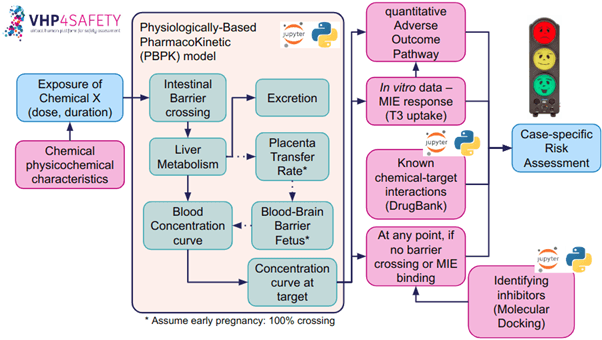
The team initiated the day by sketching out a scheme to collect and combine relevant information to provide relevant answers to the regulatory question. We refined the regulatory question to enhance clarity and specificity, with the aim of creating an interface devoted to mothers and their doctors. The envisioned platform would display compound data, assess exposure risk, and identify hazards linked to hypothyroidism. Potential questions from users, such as "Will this chemical harm my baby?" or "Does this put my patient or their developing child at risk?" guided our development process.
A GitHub folder was established to facilitate organized development, keeping notes and storing parts of the code. Despite the time constraints, our team explored diverse approaches that fit into a coherent pipeline or workflow. This included a Physiologically-Based PharmacoKinetic (PBPK) model, exploration of chemical databases and analysis of chemical-protein interactions, a Quantitative Structure-Activity Relationship (QSAR) model to predict Molecular Initiating Event (MIE) activation, and an expanded list of MIE targets based on literature. To further increase the impact of our approaches, we envisioned expanding our individual approaches and by integrating the diverse components.
Our efforts resulted in a collection of Jupyter notebooks, representing approaches to addressing parts of the regulatory question. After presenting our work and hearing from the results of other groups, our team was thrilled to be named the winner of the day's challenge. The acknowledgement was met with pride, and we anticipate further contributions to the VHP4Safety project that build on what was started during the hackathon.